
Technology is supposed to make life easier. Yet businesses and individuals frequently find themselves spending valuable time managing paperwork, maintaining spreadsheets, searching for information, and repeating administrative tasks that should be simple.
Many of these frustrations share a common characteristic: the problem isn’t particularly complicated, but the process used to manage it has become unnecessarily difficult.
Fortunately, solving these problems doesn’t always require a comprehensive software platform. Sometimes a focused application designed around a specific task is the better solution.
Here are five everyday problems that practical software can help solve.
1. Keeping Track of Customers and Service Work
For small service businesses, keeping track of customer information, service requests, and completed work can become a challenge as the business grows.
Customer details may be stored in spreadsheets, job information may be recorded on paper, and important notes may be scattered across emails or text messages.
When information is difficult to locate, employees spend more time searching for answers and less time serving customers.
A centralized system for organizing customer information and service activity can help reduce these problems.
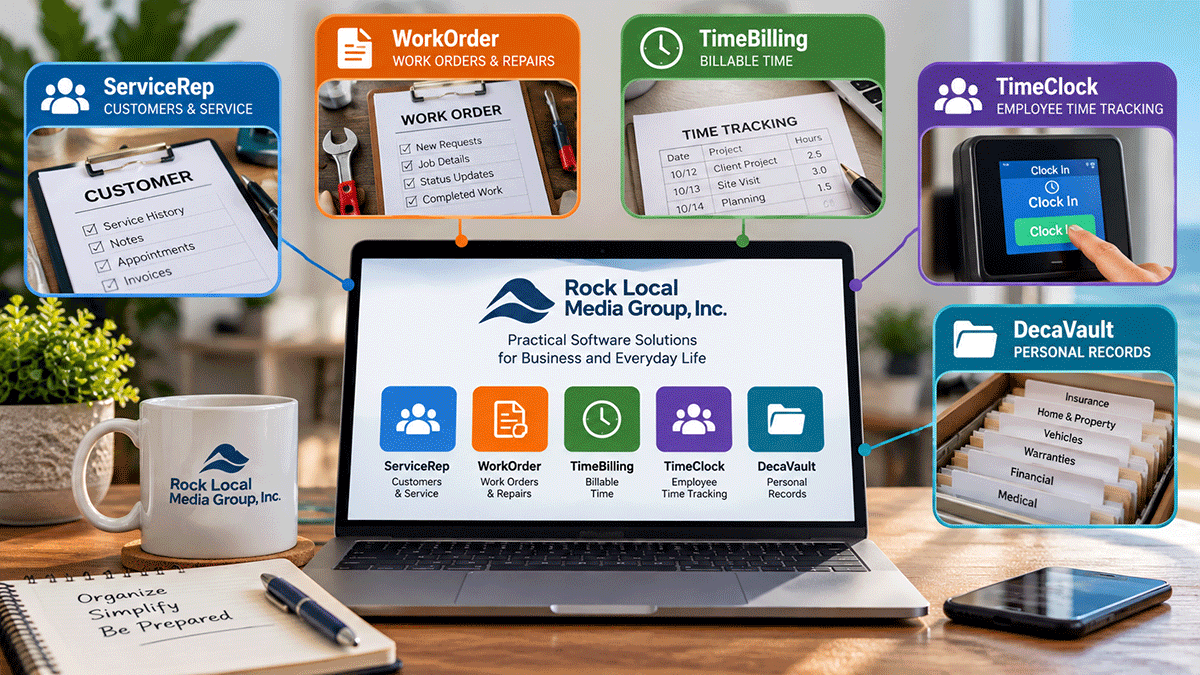
ServiceRep, part of the Local Service Rep software family, focuses on helping service businesses organize customer and service operations without requiring an unnecessarily complicated business management platform.
The objective is straightforward: keep essential business information organized and accessible when it’s needed.
2. Managing Work Orders Without Losing Important Details
Work orders are an essential part of many businesses, particularly those involved in repairs, maintenance, and equipment service.
Unfortunately, work orders are often managed through a combination of handwritten forms, spreadsheets, emails, and informal communication.
This approach can make it difficult to answer basic questions:
- What work needs to be completed?
- Who requested the work?
- What is the current status?
- What work has already been performed?
- Where can the completed work history be found?
When those answers aren’t readily available, administrative work increases and important details can be overlooked.
A dedicated work order application provides a more consistent way to organize and manage this information.
WorkOrder is designed to help businesses manage work orders and maintain organized records of repair and service activity.
Rather than forcing a business to adapt to a complicated system, the goal is to make everyday work order management more manageable.
3. Recording Time Without Complicated Procedures
Time is one of the most important resources in any business, but tracking it accurately can be surprisingly frustrating.
There are two common situations where businesses need reliable time records.
Tracking Billable Time
Consultants, contractors, and other professionals often need to record the time spent working on customer projects or providing services.
When time is recorded inconsistently, preparing accurate invoices becomes more difficult, and billable work may be overlooked.
TimeBilling addresses the need to track time associated with client work and billing.
Tracking Employee Work Hours
Businesses with hourly employees face a different challenge: recording when employees begin and finish their work.
Handwritten timesheets and manually maintained spreadsheets can introduce errors and create unnecessary administrative work.
TimeClock provides a focused approach to employee time tracking.
Although both applications involve recording time, they solve different problems. One focuses on billable customer work, while the other addresses employee timekeeping.
Recognizing that distinction is an example of why purpose-built applications can be more practical than trying to make one complicated system handle every possible requirement.
4. Finding Important Personal Information When You Need It
Not every information management problem occurs in a business.
Consider how much important personal information the average household accumulates over time.
Insurance policies, vehicle records, warranties, account information, property documents, and other important details may be stored in different locations.
Some information is kept in filing cabinets. Other records may be stored on a computer, buried in email messages, or saved in online accounts.
Finding a specific piece of information can become frustrating, especially when it’s needed unexpectedly.
For example, imagine trying to locate the warranty information for a household appliance that suddenly stops working. The receipt may be in one location, the warranty document somewhere else, and the purchase date may have been forgotten entirely.
A consistent approach to organizing important records can eliminate much of that uncertainty.
DecaVault was developed to address the everyday challenge of keeping important personal information and records organized.
The goal is to make information easier to manage and locate rather than relying on memory or searching through multiple storage locations.
5. Paying for More Software Than You Actually Need
One of the less obvious technology problems facing small businesses is purchasing software that includes far more functionality than the business requires.
Many software platforms bundle scheduling, accounting, customer management, employee administration, marketing, reporting, and numerous other features into a single subscription.
For some organizations, that approach makes sense.
For others, it creates additional expense, training requirements, and administrative complexity.
A small business that simply needs to organize work orders shouldn’t necessarily have to purchase an entire enterprise management system.
Likewise, a business that needs accurate employee time records may not require a complete human resources and payroll platform.
Before selecting software, it helps to ask a few basic questions:
- What specific problem are we trying to solve?
- How much time does the current process consume?
- Which features are genuinely necessary?
- Will the software simplify the process or introduce additional steps?
- Is the cost reasonable compared with the value provided?
These questions help keep software decisions focused on practical results rather than lengthy feature lists.
Our Approach: Solve the Problem, Not Every Possible Problem
At Rock Local Media Group, Inc., we believe effective software begins with understanding the problem.
Our approach follows three principles:
- Find the pain. Identify a genuine problem that creates unnecessary work, expense, or frustration.
- Validate the need. Determine whether solving the problem would provide meaningful value.
- Design the simplest possible solution. Build software that addresses the need without introducing unnecessary complexity.
This philosophy guides the development of our software products, including the Local Service Rep family of business applications and DecaVault for personal information organization.
Each product focuses on a particular set of everyday challenges rather than attempting to become an all-purpose software platform.
Better Software Starts With a Better Question
When evaluating technology, it’s tempting to begin by comparing features, subscription plans, and product demonstrations.
But a more useful starting point is often a simpler question:
What task is taking more time or effort than it should?
That question shifts the focus from purchasing technology to solving a real problem.
Whether the challenge involves managing service customers, organizing work orders, tracking time, or locating important personal records, the right software should make the process easier to manage.
Sometimes the most valuable technology isn’t the system that does everything.
It’s the application that does exactly what you need.
Explore Our Software Solutions
At Rock Local Media Group, Inc., we develop practical, affordable software that solves everyday problems without unnecessary complexity. Explore our products and services:
- Software Solutions – Discover our software products for businesses and individuals.
- Custom Application Development – Learn how we design and develop software tailored to specific business needs.
- Local Service Rep – Explore ServiceRep, WorkOrder, TimeBilling, and TimeClock, our family of small business software applications.
- DecaVault – Organize and manage important personal information and records.
Learn more about our approach to software development in Why Simple Software Builds Stronger Businesses.