
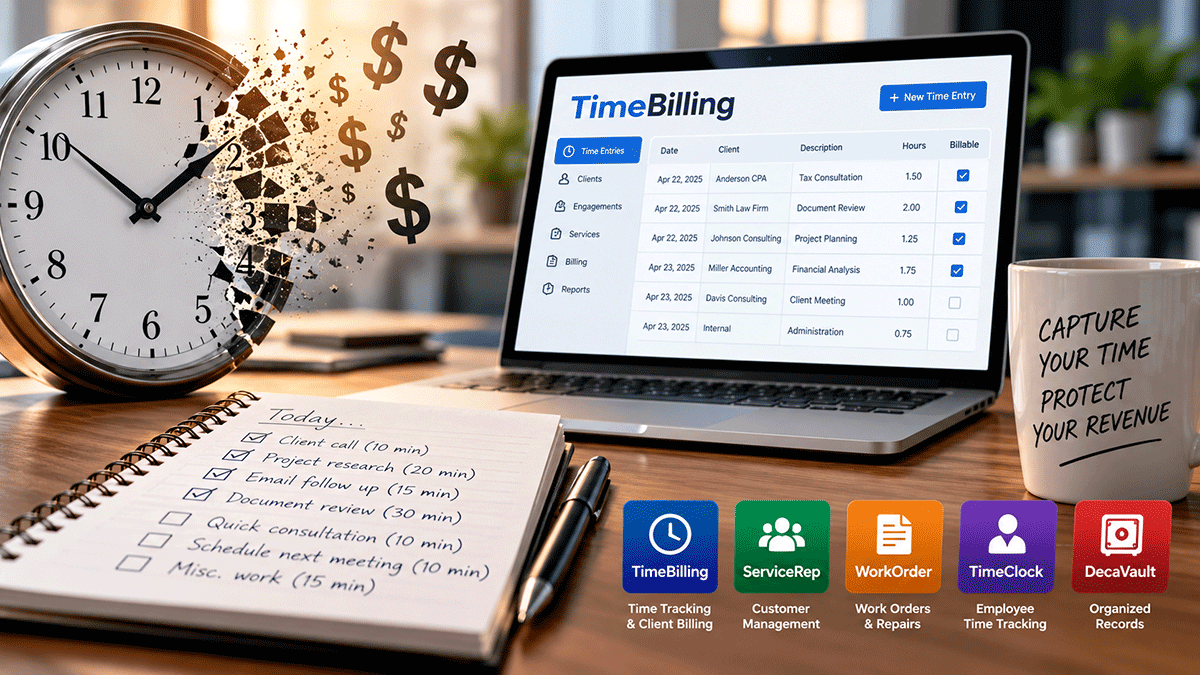

The Hidden Cost of Lost Billable Time for Small Businesses
For many small businesses, time is one of their most valuable resources. Consultants, accountants, attorneys, repair professionals, and service providers depend on the hours they invest in serving customers and completing projects.
Yet one of the most common sources of lost revenue is surprisingly simple: work gets performed, but the time spent performing it is never properly recorded.
A short telephone consultation, an unexpected customer request, a few minutes researching a problem, or an additional service performed during a busy afternoon can easily disappear from the billing process.
At Rock Local Media Group, we believe business software should solve these everyday problems without introducing unnecessary complexity. That philosophy guides the development of our Local Service Rep family of applications, including TimeBilling, a progressive web application (PWA) designed to help independent professionals and small businesses capture their time, organize client work, and prepare accurate billing records.
Why Small Businesses Lose Billable Time
Most lost billable time is not the result of carelessness. It happens because recording time often competes with the work itself.
Consider a typical day for an independent professional. A client calls with a question. Another customer needs a quick document review. A project requires an unexpected adjustment. Between scheduled appointments, several smaller tasks demand attention.
Each activity may take only a few minutes, but those minutes accumulate.
When time recording is postponed until the end of the day or week, the business owner must reconstruct those activities from memory, calendar entries, emails, and handwritten notes.
Some activities are remembered. Others are forgotten entirely.
How Much Can a Few Forgotten Minutes Cost?
Consider a hypothetical professional who bills $100 per hour and unintentionally overlooks just 15 minutes of otherwise billable work each business day.
- 15 minutes of unrecorded time per day
- 5 business days per week
- Approximately 5 hours of lost billable time over a four-week period
- $500 in potentially unbilled services during that period
- Approximately $6,000 over 48 working weeks
These figures are illustrative, not measured customer results. Actual financial impact depends on the work performed, billing arrangements, and whether the overlooked time would otherwise have been invoiced and collected.
Nevertheless, the example demonstrates an important principle: small amounts of unrecorded time can represent meaningful revenue opportunities.
Capture the Time First. Organize the Details Later.
One reason professionals postpone recording their time is that traditional systems may require too much information before they can begin.
They may need to select a customer, identify a project, choose a service category, establish a billing rate, and enter a description before recording the activity.
When a customer is waiting or an urgent problem requires attention, those administrative steps can become an obstacle.
TimeBilling approaches the problem differently.
The application allows users to start recording time immediately, without first selecting a client, engagement, service, or billing rate.
When the activity is complete, the recorded time can be assigned to the appropriate client and engagement. Service information, rates, notes, and billable status can then be added.
This approach separates two important activities: capturing the time when the work occurs and organizing the administrative details afterward.
Learn more about TimeBilling time tracking and billing software.
Different Businesses, Similar Time Tracking Problems
Although businesses operate in different industries, many experience remarkably similar challenges when recording professional time.
Our Local Service Rep case study collection explores how focused software can address these challenges across a variety of business environments.
Accounting and CPA Firms
Accountants frequently move between tax preparation, bookkeeping, financial reviews, client consultations, and administrative responsibilities.
Some services are billed hourly, while others involve fixed fees or recurring arrangements.
Regardless of the billing method, maintaining accurate time records helps accounting professionals understand how much work each client requires.
For example, an accounting firm may discover that a fixed-fee engagement consistently requires more time than originally estimated. Accurate records provide useful information when evaluating future pricing.
Our CPA and Accounting Firm Case Study illustrates how a small practice can organize client engagements and maintain more consistent billing records.
Attorneys and Small Law Firms
Legal professionals often divide their work among consultations, research, document preparation, client communications, and case-related activities.
Accurate time records are especially important when services are billed hourly or when a firm needs to evaluate the effort associated with particular matters.
A consistent recording process can reduce dependence on reconstructed timesheets and provide clearer documentation of professional services.
Our Law Firm Business Case Study examines these challenges in a small legal practice.
Business Consultants
Independent consultants may work with several clients during a single day, often switching between meetings, research, analysis, recommendations, and project management activities.
Without a reliable recording process, short consultations and follow-up activities may never appear in the final billing records.
Time tracking also provides valuable information for fixed-fee consulting engagements by helping professionals understand the actual effort required to complete a project.
Our Business Consulting Firm Case Study illustrates how organized time records support client billing and project evaluation.
Billable Time and Non-Billable Time Both Matter
Not every hour worked can or should be billed to a customer.
Business owners also spend time on administration, marketing, internal meetings, training, and other activities necessary to operate their businesses.
Understanding the difference between billable and non-billable time provides a more complete picture of how the workday is spent.
For example, a consultant who works eight hours but records only four hours of client-related activity may want to understand where the remaining time went.
Some of that time may represent necessary business administration. Other activities may reveal opportunities to improve scheduling, reduce interruptions, or simplify routine processes.
TimeBilling supports billable and non-billable service classifications, allowing recorded activities to be organized according to their purpose.
Accurate Time Records Improve More Than Billing
Even businesses that do not bill customers by the hour can benefit from understanding how much time their work requires.
Consider a service provider who charges a fixed amount for a particular job.
If the work consistently takes longer than anticipated, the business may be earning less than expected after accounting for labor and other expenses.
Accurate time records help answer practical questions:
- Which clients or projects require the most time?
- Are certain services taking longer than expected?
- How much time is devoted to billable versus non-billable activities?
- Are fixed-fee projects priced appropriately?
- How much time is spent on work that never reaches the billing process?
These questions are not limited to professional service firms. They also matter to repair businesses, field service companies, and other small operations where labor represents a significant operating expense.
Why Simple Software Often Makes More Sense
Small businesses have access to an enormous variety of business management applications.
Many offer extensive features for project management, accounting, customer relationships, scheduling, reporting, and enterprise operations.
Those capabilities can be valuable, but they are not always necessary.
An independent consultant who primarily needs to record time and prepare billing details may not require a comprehensive professional services platform.
Likewise, a small repair shop may need dependable work order tracking without the expense and complexity of a large service management system.
At Rock Local Media Group, our development philosophy is straightforward: identify the problem, understand the workflow, and build a practical solution around the work people actually perform.
Software should make routine business activities easier, not create another administrative responsibility.
The Local Service Rep Family: Focused Tools for Different Business Needs
TimeBilling is part of the broader Local Service Rep family of business applications developed by Rock Local Media Group, Inc.
Rather than assuming every business needs the same comprehensive software package, the product family provides applications focused on different operational requirements.
TimeBilling — Professional Time Tracking and Client Billing
TimeBilling helps independent professionals and small firms record time, organize clients and engagements, manage service rates, and prepare detailed billing reports.
Its progressive web application design makes it accessible through supported web browsers and allows installation on compatible devices.
ServiceRep — Service Business Management
ServiceRep focuses on organizing customers, service locations, service activity, and related business records.
It is designed for businesses that need to manage ongoing customer service relationships and maintain organized operational information.
WorkOrder — Work Order and Repair Management
WorkOrder helps businesses create, assign, and track work orders while maintaining records of the work performed.
It is particularly relevant to repair shops and service businesses that need a structured process for managing jobs from intake through completion.
TimeClock — Employee Time Tracking
TimeClock addresses a different time tracking requirement: recording employee working hours.
While TimeBilling focuses on professional services and client billing, TimeClock is intended for businesses that need to maintain employee time records.
DecaVault — Organized Personal and Business Records
DecaVault provides a way to organize important information and maintain structured records for personal and business-related needs.
Its specialized tracking applications address practical recordkeeping activities that might otherwise depend on spreadsheets, handwritten notes, or disconnected files.
Learning From Realistic Small Business Workflows
To demonstrate how these applications address everyday operational challenges, Local Service Rep publishes business case studies covering a variety of industries.
These studies use realistic, illustrative business scenarios to examine common administrative problems and show how a more organized workflow could improve recordkeeping.
They are not presented as testimonials or documented financial results from actual customers.
The collection includes professional service firms, repair businesses, mobile service providers, employee time tracking scenarios, and specialized recordkeeping applications.
Although the industries differ, a consistent theme emerges: small businesses benefit when important information is recorded promptly, organized logically, and available when needed.
Explore the Business Consulting Firm Case Study, CPA and Accounting Firm Case Study, or Law Firm Business Case Study to see how time tracking and billing challenges appear in different professional environments.
Better Records Begin With a Better Process
Technology alone cannot eliminate every administrative challenge. A business must also establish consistent procedures for recording work and maintaining accurate information.
However, the right software can make those procedures considerably easier to follow.
For businesses that depend on billable professional time, the starting point is simple: record the work when it happens instead of trying to remember it later.
For other small businesses, the same principle applies to customer records, work orders, employee hours, and important operational information.
Good software should support these everyday activities without forcing business owners to reorganize their operations around complicated systems.
Explore TimeBilling and Local Service Rep
Rock Local Media Group develops practical software for independent professionals, small businesses, and organizations that need useful tools without unnecessary complexity.
If your business struggles with forgotten billable hours, scattered client records, or time-consuming billing preparation, explore TimeBilling to learn how its time recording and billing features work.
TimeBilling is available for $24.95 per month and includes a free 14-day trial.
To explore additional applications for customer management, work orders, employee time tracking, and organized records, visit Local Service Rep.
Our goal is simple: build software that helps people spend less time managing information and more time doing productive work.
Explore Our Software Solutions
Rock Local Media Group, Inc. develops practical, affordable software designed to solve everyday problems without unnecessary complexity.
- Software Solutions – Explore our software products for businesses and individuals.
- Custom Application Development – Learn about our approach to building software for specific business needs.
- Local Service Rep – Discover our family of small business software applications.
- DecaVault – Explore practical tools for personal information management and recordkeeping.
For additional insights, read Why Simple Software Builds Stronger Businesses.